
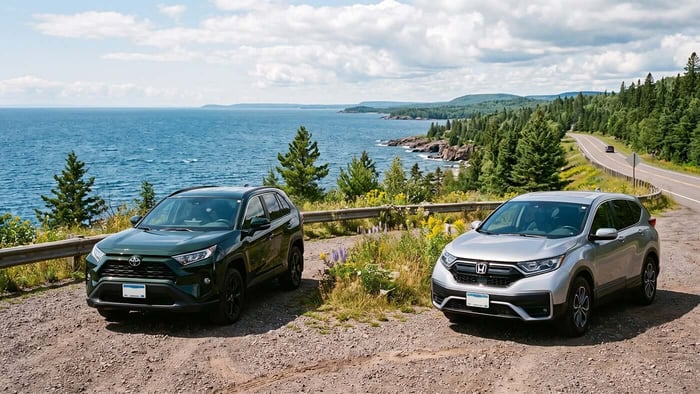

The Toyota RAV4 and Honda CR-V are two of the most popular compact SUVs for good reason. Both are reliable, fuel-efficient, and practical. The right choice depends on whether you value performance and resale (RAV4) or comfort and space (CR-V).
Below is a breakdown using current-generation specs, with links to live inventory from CarSoup's nationwide dealer network so you can move from research to a test drive.
Table of Contents
- Toyota RAV4 vs Honda CR-V Specs Comparison
- Toyota RAV4 vs Honda CR-V Performance Comparison
- Toyota RAV4 vs Honda CR-V Interior and Passenger Space
- Toyota RAV4 vs Honda CR-V Cargo Space Comparison
- Toyota RAV4 vs Honda CR-V Technology and Safety Features
- RAV4 Hybrid vs CR-V Hybrid: Which Delivers Better Value?
- Toyota RAV4 Hybrid vs Honda CR-V: Resale Value and Total Cost of Ownership
- Toyota RAV4 vs Honda CR-V: Final Verdict
- FAQs
Toyota RAV4 vs Honda CR-V Specs Comparison
Specification | Toyota RAV4 | Honda CR-V |
Starting MSRP | ~$29,250 | ~$30,100 |
Engine options | 2.5L I4 gas; 2.5L hybrid; 2.5L plug-in hybrid | 1.5L turbo I4 gas; 2.0L hybrid |
Horsepower | 203 hp (gas); 219 hp (hybrid); 302 hp (Prime PHEV) | 190 hp (turbo); 204 hp (hybrid) |
Torque | 184 lb-ft (gas) | 179 lb-ft (turbo); 247 lb-ft (hybrid) |
Fuel economy (combined) | Up to 39 mpg (hybrid) | Up to 40 mpg (hybrid) |
Hybrid availability | Yes, plus plug-in hybrid (RAV4 Prime) | Yes, standard hybrid only |
Cargo capacity (behind 2nd row) | ~37.6 cu ft | ~39.3 cu ft |
Seating capacity | 5 | 5 |
Max towing | Up to 3,500 lbs (Prime) | Up to 1,500 lbs |
Ground clearance | Up to 8.6 in (TRD/Adventure) | ~8.2 in |
Standard safety suite | Toyota Safety Sense 2.5 | Honda Sensing |
Infotainment | 8" or 10.5" touchscreen, wireless Apple CarPlay/Android Auto | 7" or 9" touchscreen, wireless Apple CarPlay/Android Auto |
Toyota RAV4 vs Honda CR-V Performance Comparison
The RAV4's gas engine makes 203 horsepower and feels eager off the line, while the available TRD Off-Road and Adventure trims add genuine trail hardware. If you tow a small trailer or want the most powerful option, the RAV4 Prime plug-in hybrid produces 302 horsepower and hits 60 mph in under six seconds, which is quick for the class.
The CR-V takes the opposite approach. Its 1.5L turbo is tuned for low-end pull, and the cabin stays noticeably quieter at highway speeds. On long commutes and road trips, that ride composure is its strongest argument; the RAV4 transmits more of the road, which some drivers read as engaging, and others read as firm. The two hybrids are nearly tied on fuel economy, so drivetrain choice should hinge on power and capability rather than a single mpg point.
Toyota RAV4 vs Honda CR-V Interior and Passenger Space
Inside, the CR-V feels like the more grown-up of the two. Honda's current cabin uses soft-touch materials, a clean horizontal dashboard, and a hidden-vent design that looks a class above its price. Rear-seat legroom is generous, making it a strong pick for families with teenagers or rear-facing car seats.
The RAV4's interior is more rugged and utilitarian, with chunky controls and durable surfaces that shrug off muddy boots and dog hair, making it the better fit for active buyers who treat their SUV like gear. The CR-V's center console and door bins are thoughtfully sized for daily clutter, and its rear seats recline for comfort. If interior refinement tops your list, scan available Honda CR-V models to compare trim-level materials in person.
Toyota RAV4 vs Honda CR-V Cargo Space Comparison
Cargo is where the CR-V holds a measurable edge. With the rear seats up, it offers roughly 39.3 cubic feet versus the RAV4's 37.6, and that gap widens with the seats folded. For Costco runs, strollers, and the occasional furniture haul, the CR-V swallows a bit more without complaint.
The RAV4's squared-off cargo area loads easily, but families who pack to the roof will appreciate the CR-V's extra room and lower load floor. Both offer 60/40 split rear seats and wide hatch openings that make car-seat installation and grocery loading straightforward. The RAV4's all-wheel-drive capability and higher ground clearance pay off on gravel roads and snowy passes. Buyers weighing space against capability often cross-shop a wagon-style alternative; our used Toyotas and Subaru Outback dealings are worth a look before you decide.
Toyota RAV4 vs Honda CR-V Technology and Safety Features
Both SUVs now ship with wireless Apple CarPlay and Android Auto, which removes a common past complaint. The RAV4 offers an available 10.5-inch touchscreen on higher trims, while the CR-V tops out at a crisp 9-inch unit with a physical volume knob that's easy to use on the move.
Toyota Safety Sense 2.5 and Honda Sensing both come standard and cover the essentials: adaptive cruise control, lane-keeping assist, automatic emergency braking, and road-sign recognition. Honda's lane-centering feels smoother in stop-and-go traffic; Toyota's system is praised for consistent, predictable behavior.
For families, both earn strong marks, with top crash-test scores from the IIHS and NHTSA across recent model years plus rear-seat reminders and available blind-spot monitoring. If smartphone integration and driver-assist polish drive your decision, the CR-V's interface has a slight usability lead.
RAV4 Hybrid vs CR-V Hybrid: Which Delivers Better Value?
The CR-V Hybrid posts up to 40 mpg combined and delivers a smooth, refined power delivery that suits commuters. The RAV4 Hybrid returns up to 39 mpg, accelerates a touch harder, and is the only one of the two with a plug-in option for buyers who want short all-electric commutes.
Over a typical five-year hold, fuel costs between the two are nearly identical, so the decision comes down to driving character and whether you want plug-in capability. Both hybrid systems have earned reputations for durability, though Toyota's powertrain has a longer track record across millions of vehicles, which gives risk-averse buyers extra confidence. Drivers chasing the lowest running costs should compare hybrid trims within available Toyota models and Honda inventory to balance price and mileage.
Toyota RAV4 Hybrid vs Honda CR-V: Resale Value and Total Cost of Ownership
The RAV4 is the resale champion of the two. Toyota's compact SUV consistently retains a higher percentage of its value after five years, which means lower true cost of ownership even when the purchase price is similar. For buyers who trade in every few years, that edge adds up to real money.
The CR-V holds its value well too, just a step behind. Factoring insurance, fuel, maintenance, and depreciation together, the RAV4 usually finishes slightly ahead on total cost of ownership, with the CR-V close enough that comfort and cargo can justify the difference. If you're building a broader shortlist, our best used SUV listings can further aid you whether the RAV4 or CR-V truly fits your needs.
Toyota RAV4 vs Honda CR-V: Final Verdict
Cross-shopping is the smartest way to land the right SUV. If a larger three-row is on your radar, compare the Honda CR-V vs Toyota Highlander. Drivers who want a sportier drive should weigh the Toyota RAV4 vs Mazda CX-5, and value-focused shoppers often add the Honda CR-V vs Nissan Rogue to the mix before deciding.
FAQs
Is the RAV4 Hybrid better than the CR-V Hybrid?
It depends on priorities. The RAV4 Hybrid accelerates harder and offers a plug-in version (RAV4 Prime) with 302 horsepower, while the CR-V Hybrid is quieter and slightly more fuel-efficient at up to 40 mpg combined. Fuel costs over five years are nearly identical, so it comes down to power versus refinement.
Which SUV is better for families?
The CR-V is often the better family pick thanks to its roomier rear seat, larger cargo area, and quieter cabin. Both earn top crash-test scores and include standard driver-assistance features, so families who prioritize toughness, towing, or resale may still prefer the RAV4.
Can the RAV4 or CR-V tow a trailer?
The RAV4 is the stronger tow vehicle. Standard models tow modest loads, but the RAV4 Prime is rated up to 3,500 pounds, well above the CR-V's 1,500-pound limit. If light towing matters, the RAV4 is the clear choice.
How do RAV4 and CR-V maintenance costs compare over time?
Both SUVs are known for low long-term maintenance costs relative to the compact SUV class, and routine service (oil changes, brakes, tires) runs similarly between the two. The RAV4's hybrid system has a longer real-world track record given how many units Toyota has sold since 2016, which tends to translate into more affordable aftermarket parts and wider service familiarity at independent shops.
Is all-wheel drive standard on both the RAV4 and CR-V?
Neither SUV comes with standard all-wheel drive on every trim — both are available with front-wheel drive as the base configuration, with AWD as an upgrade on most trims. If AWD is a must-have, checking the specific trim's drivetrain before buying is worth doing, since availability varies by year and package.
Is the RAV4 or CR-V better for winter driving?
Both come with capable all-wheel-drive systems, but the RAV4's extra ground clearance (up to 8.6 inches on TRD/Adventure trims versus the CR-V's roughly 8.2 inches) gives it a slight edge in deep snow or unplowed lots. For Minnesota drivers who deal with slushy winters, that clearance difference is worth noting, though both SUVs handle typical winter commuting without issue.