
Table of Contents
The automotive world is currently standing on a fault line. On one side, we have the established order of internal combustion—mechanical, visceral, and finite. On the other, the electric revolution—rapid, efficient, and often criticized for being clinically sterile. Nowhere is this friction more palpable than in a showdown between the 2025 BMW M2 and the Hyundai Ioniq 5 N.
If you looked at the spec sheets ten years ago, this comparison would have been laughable. A South Korean hatchback racing a BMW M car? But today, this is the heavyweight title fight for the soul of the enthusiast. The question isn't just about speed; it is about whether a digitally synthesized experience can ever replace the mechanical heartbeat of a legend.
The Last Bastion: BMW M2
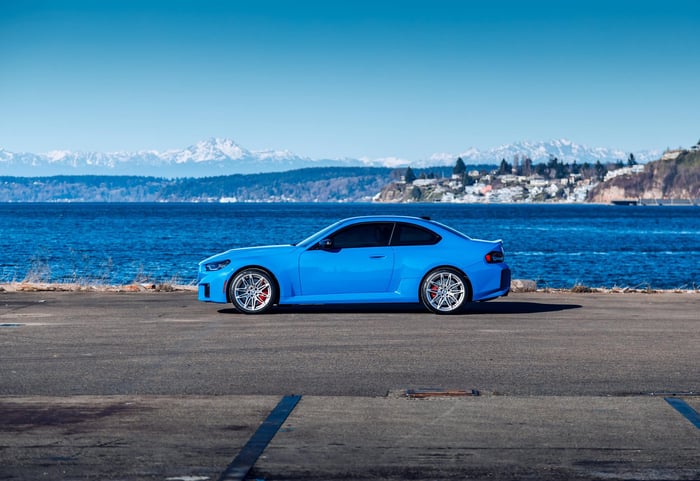
The BMW M2 represents the "Soul" in this equation, arguably one of the last pure drivers' cars on sale. It adheres to a formula that is rapidly going extinct: a twin-turbocharged 3.0-liter inline-six engine upfront, power sent exclusively to the rear wheels, and—crucially—an available six-speed manual transmission.
With 473 horsepower and 406 lb-ft of torque (bumped to 443 lb-ft in the automatic), the M2 is not slow. It sprints to 60 mph in roughly 3.9 seconds with the stick shift, or 3.5 seconds with the 8-speed automatic. But the M2 has never been purely about numbers. It is about the connection.
Driving the M2 is a conversation. You feel the road texture through the chassis; you manage the slip angle of the rear tires with your right foot. The S58 engine needs to be revved to extract its best work, screaming to a 7,200 rpm redline with a mechanical cacophony that no speaker system can perfectly replicate. It is a car that demands you work for your speed. It weighs around 3,800 lbs—heavy for a small coupe, but light compared to its electric rival. It feels dense, muscular, and inherently organic.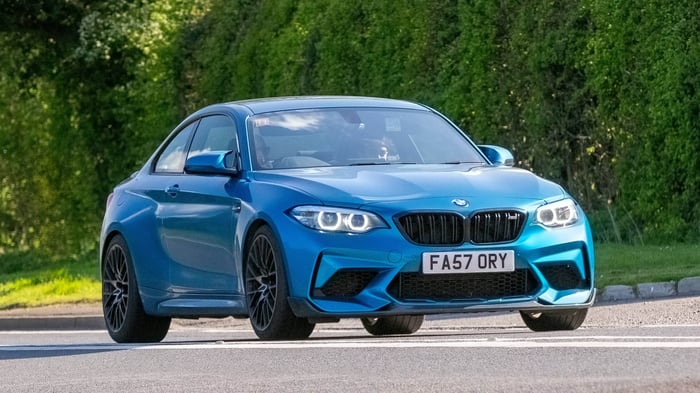
The Digital Sorcerer: Hyundai Ioniq 5 N
If the M2 is a mechanical watch, the Ioniq 5 N is an Apple Watch Ultra simulating a ticking mechanism. On paper, it shouldn’t work as a driver’s car. It is a crossover. It weighs a mammoth 4,861 lbs. It is electric, which usually implies a numbness of character.
And yet, Hyundai has done the impossible: they have weaponized the simulation.
The Ioniq 5 N packs dual motors generating 601 horsepower (641 hp with the "N Grin Boost" button). It decimates the M2 in a straight line, hitting 60 mph in about 3.25 seconds. But the "Silence" usually associated with EVs is absent here. Hyundai engineers realized that speed without sensation is boring, so they introduced N e-shift and N Active Sound+.
This system simulates the jolts, revs, and power interruptions of an 8-speed dual-clutch transmission. It plays engine noises (or jet fighter sounds, if you prefer) through the speakers and vibrates the chassis to mimic a combustion engine at idle. It sounds gimmicky until you drive it. The "fake" shifts provide the cues your brain needs to judge corner entry speed. The simulated redline forces you to engage with the car rather than just mashing a pedal. It defies physics, masking its 2.4-ton mass with torque-vectoring wizardry that makes it turn in sharper than it has any right to.
The Clash: Analog Feedback vs. Digital Theatre
On a back road, the differences amplify. The BMW M2 offers a reward structure based on physics. Nail a heel-toe downshift, and the satisfaction is entirely yours; you manipulated the machine perfectly. The car rotates naturally, the front end bites with precision, and the slide is progressive. It is the culmination of 50 years of motorsport heritage distilled into a coupe.
The Ioniq 5 N, however, offers a reward structure based on theatre. When you "downshift" into a corner, the motors apply negative torque to pitch the weight forward, simulating engine braking. It’s code mimicking mechanics, but the result is startlingly effective. You find yourself giggling—not because of the purity of the drive, but because of the sheer audacity of the engineering.
However, the cracks in the simulation do appear. Push the Ioniq 5 N too hard for too long, and you are reminded of the laws of thermodynamics. Batteries get hot; tires shriek under the immense weight. The M2, by contrast, feels like it could run laps until the fuel tank runs dry, lighter on its feet and more consistent in its feedback.
The Verdict
If you are a purist who believes the bond between man and machine is forged in oil and gears, the BMW M2 is the winner. It is a future classic, likely one of the final chapters of the internal combustion performance book. It offers an authentic experience that requires no software updates to feel real.
But to dismiss the Hyundai Ioniq 5 N is to ignore the future. It proves that the electric era doesn't have to be boring. It doesn't just transport you; it entertains you. It acknowledges that we crave the imperfections of combustion—the noise, the shifts, the drama—and it recreates them in a package that is faster and more practical than the BMW.
The BMW M2 wins the battle for the heart, keeping the flame of "Soul" alive. But the Ioniq 5 N wins the battle for the mind, proving that even in a digital world, we don't have to suffer in silence.